
In the Spring of 1999, young people across the country began to prepare for that singular teenage right of passage: Prom. For Diamond Stylz, this time included not just finding the right dress and corsage, but fighting for her right to attend prom at all. School administrators had told the then 17-year-old Stylz just two days before prom that she could not attend the event wearing a dress, despite living as a woman for years.
“At that time,” Stylz reflects, her teachers were “really adamant about teaching me to be a boy” in deference to the cultural sensationalism that trans individuals were somehow wrong.
Stylz knew she wasn’t wrong — the school was. She made the decision to fight this attempt to discriminate against her right to be who she is. With the American Civil Liberties Union of Indiana, Stylz successfully sued her school, arguing that their actions violated her First Amendment rights.
“There was so much empowerment [in the decision to fight back],” Stylz explains. But also a lot of shame that Stylz says she “didn’t need to own” at just 17. After working through her shame, and anger, today she’s allowed her experience to inform her work as a trans rights advocate.
Stories like Stylz’ still resonate nearly three decades later because the right for trans individuals to live authentically is still under attack. Right now, politicians across the country have proposed — and in some states passed — anti-trans laws that attempt to restrict access to gender-affirming care, deny people their right to self expression, bar young people from playing sports and much more. These powerful politicians use their public platforms to spread anti-trans rhetoric that is discriminatory, often false and, most alarmingly, that endangers trans lives.
As the alleged “war on woke” attempts to manipulate trans rights into flashpoints in the larger political discourse, the truth remains unchanged: Attacks on trans rights is an attack on people — their lives, their rights and their freedom to be. These partisan attempts to police bodies so they might adhere to one person’s belief system is not just wrong, it's unlawful.
The ACLU and our partners have spent more than 100 years defending our First Amendment right to live authentically and our 14th Amendment right to be free from unconstitutional discrimination. Our work has not changed despite new attacks based on decade’s old prejudice. But this fight isn’t won just in the courthouse or Congress, it’s won — and led — by the trans community.
Trans individuals, like Stylz, who risk their health to take a stand for their rights have won freedoms for their community for more than 40 years. Most notably, Marsha P. Johnson, the Black trans woman and activist who led the Stonewall uprising in New York City in 1969, helped to establish a nationwide movement for trans rights that fought police brutality. In particular, trans women of color, like Stylz and Johnson, or Imara Jones or Sylvia Riviera, face an outsized risk in their efforts to live authentically, battling both gender and racial discrimination, while fighting for their rights.
In addition to race, age can also exacerbate anti-trans discrimination. New research from the ACLU has found that trans and nonbinary teens report devastating interruptions in medically-necessary health care when politicians attempt to ban gender-affirming care. Groups like the Trans Youth Emergency Project, part of the Campaign for Southern Equality, work to help young people access the resources they need to live authentically no matter what laws exist in their state. For some, this could mean acquiring a chest binder to help heal gender dysphoria. For others, the Project helps young people living in states that have banned or restricted gender-affirming care to travel to find a provider or healthcare center that can support them.
The Trans Youth Emergency Project is but one way that the trans community has built its own safety net. While for Lizette and Jose Trujillo, whose son Daniel is trans, building safety within their own home has been vital to Daniel’s ability to thrive. The family lives in Arizona, which has advanced a series of anti-LGBTQ bills in recent years. Lizette and Jose believe that parents should have the right to consent to and access medically necessary care for their child, including gender affirming medical care.
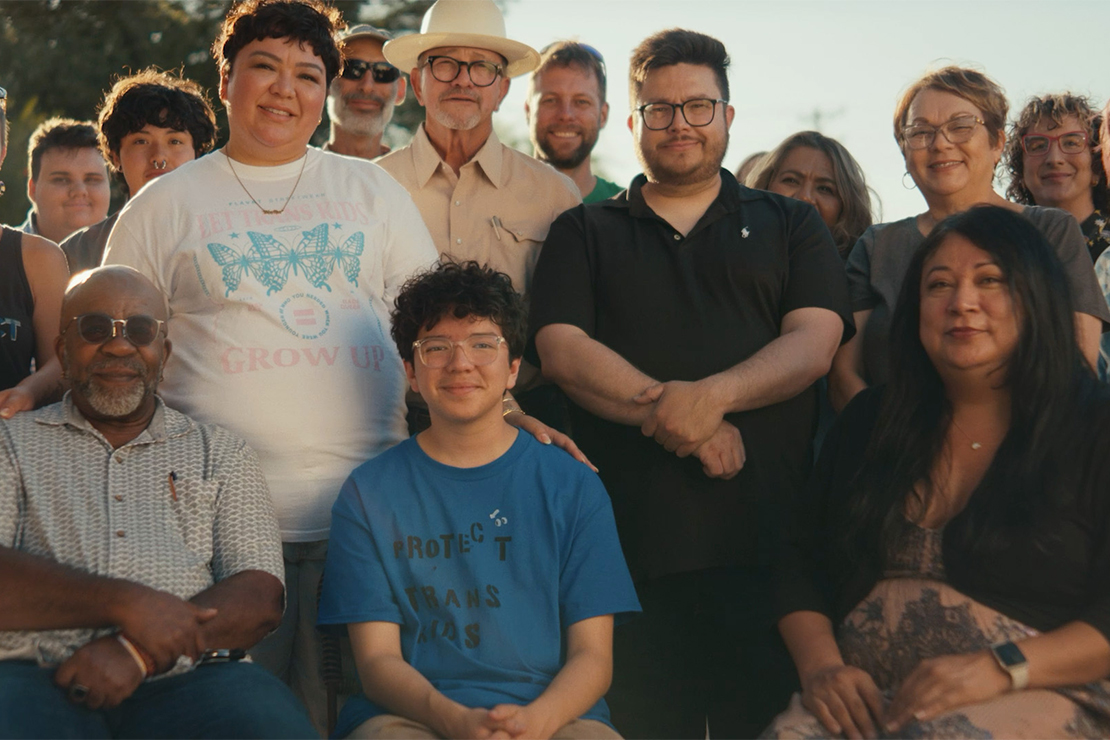
Daniel Trujillo (seated center) along with his parents, Lizette (standing, white t-shirt) and Jose (standing, black shirt) and the rest of his family.
“It was my responsibility to do whatever I needed to do to make the world safer for Daniel,” Lizette explains. “My child should have the right to access medical care that is private, medically necessary, and improves his quality of life without government intervention.”
The Trujillo family joins trans individuals across the country who are fighting for their freedom to be. The ACLU recently spotlighted their stories as a part of our ongoing efforts to showcase how, since people existed, the right to live authentically has been both vital and vulnerable. In addition to supporting trans individuals as they tell their stories, this December the ACLU, the ACLU of Tennessee, and our legal partners will argue before the Supreme Court for the right to gender-affirming care for trans minors in Tennessee. The case, US v. Skrmetti, is the first challenge to a ban on gender-affirming care to reach the Supreme Court.

“The well-being of countless transgender youth in this and future generations rests on this court adhering to the facts, the Constitution, and its own precedent both recent and long-standing,” explains Chase Strangio, co-director of the ACLU’s LGBTQ & HIV Project.
Strangio, who is leading the litigation, explains what has been true since Stylz’ First Amendment challenge in 1999 and since the Stonewall uprising in 1969, which is that trans individuals “will not find safety or justice in the courts alone. Our national culture still encounters trans people as a question to be answered or a problem to be solved.”
The trans experience is not defined solely by the people who seek to erase them, but by the ongoing fight for freedom and moments of true liberation. Twenty-four years after Stylz fought for the right to wear a dress to prom, Lizette and Jose watched their trans son Daniel don a suit and bowtie to attend the first trans prom, organized by trans teens for trans teens.
For Daniel and Stylz, and so many trans teens, prom is but one battle in the never ending fight for their rights. A battle we must all wage.
We must make “this world a safe place for us all and a free place for us all,” Stylz says. “Pursuing liberty and happiness is at the cornerstone of our Constitution. If you're not a part of that. You are part of the problem.”
Comments
Post a Comment