
After President Donald Trump issued an executive order restricting access to gender-affirming medical care for transgender people under 19, many hospitals nationwide abruptly cut off treatment for trans youth. This sent thousands of families scrambling, with some even wondering if they needed to leave the country to protect their family’s future.
If enforced, President Trump’s order will deny transgender youth access to medically-necessary care, like puberty blockers and hormone therapy, even as these same treatments remain readily available to their cisgender peers. The order also intends to cut or reduce federal funding for health care providers who refuse to prioritize the Trump administration’s political preferences over their patients’ medical needs.
"politics and partisanship have no place in patient care and we all deserve the freedom to be ourselves."
At the American Civil Liberties Union, we know that politics and partisanship have no place in patient care and we all deserve the freedom to be ourselves. On February 4th, alongside Lambda Legal and the ACLU of Maryland, we sued the Trump administration to block its discriminatory efforts to limit needed health care. We filed our suit on behalf of transgender young adults and their families, as well as PFLAG and GLMA, two of the nation’s largest organizations supporting LGBTQ+ people and healthcare professionals.
Since his first term, Trump and his administration have carried out a years-long effort to roll back protections for LGBTQ people. Beginning in January, the Trump administration issued a series of executive orders that remove protections for trans people. His directives include targeting transgender students, banning trans Americans from military service, and giving federal agencies the green light to openly discriminate against their trans employees. These orders align with the extremist vision of Project 2025, a sweeping right-wing agenda that seeks to dismantle civil rights protections, consolidate presidential power, and dehumanize transgender people.
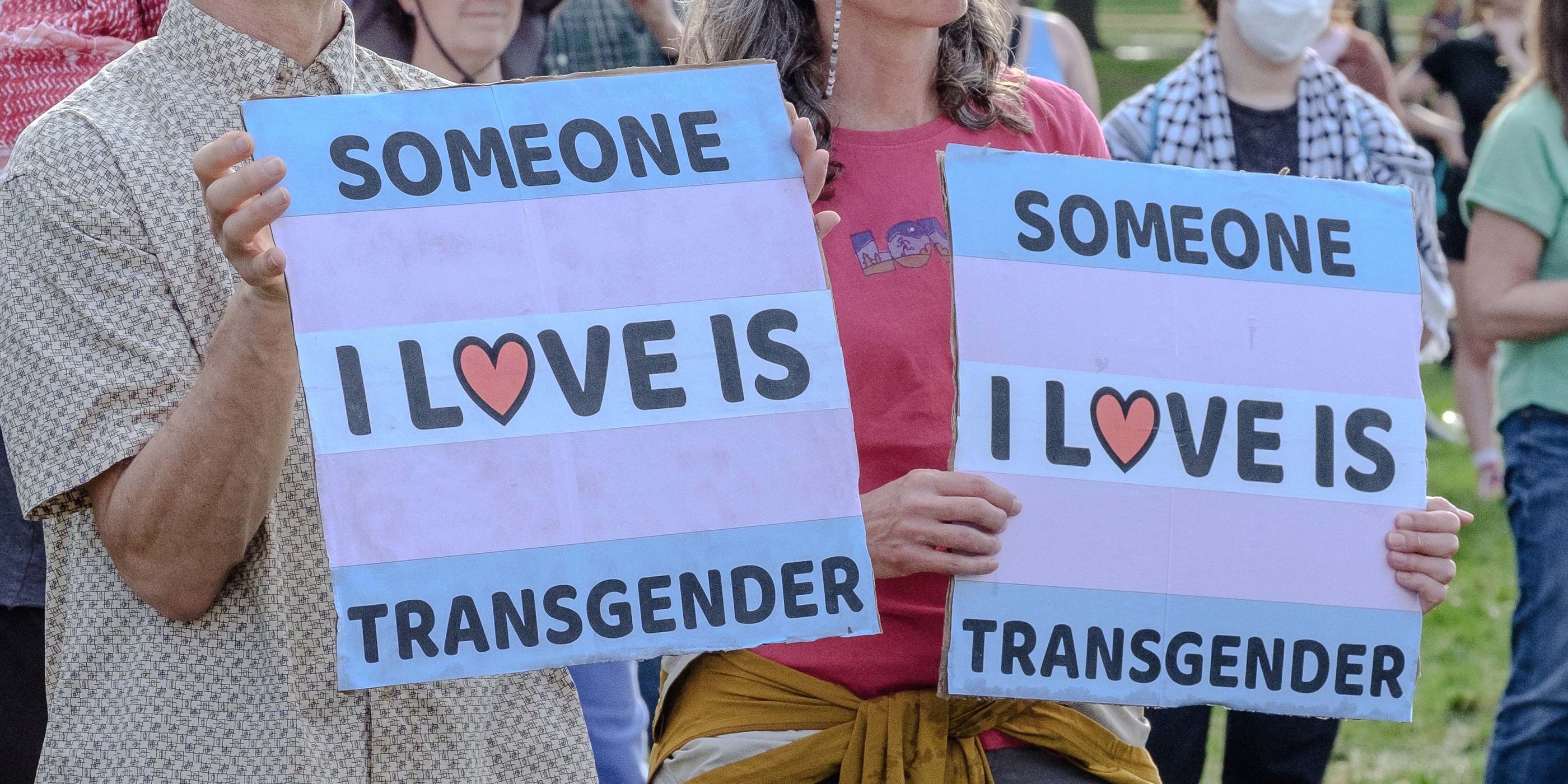
J Matt/ZUMA Press Wire/Shutterstock
President Trump “is determined to use every level of government to drive transgender people out of public life,” says Joshua Block, senior counsel for the ACLU’s LGBT & HIV Project.
For Cameron, Gabe, and Robert, three of the five trans young people challenging the Trump administration’s anti-trans agenda, this fight goes beyond the courtroom. It’s about their fundamental right to make deeply personal medical decisions without government interference.
For Cameron, words like “boy” or “girl” were never meaningful. Being seen as nonbinary makes them feel “strong, happy, recognized, and loved.” Before puberty, they worried about how others would treat them based on their clothes and pronouns. Now, as their physical-self matures, Cameron worries about how they see their own body. “The changes feel violating,” they say. “It makes me depressed, stressed, and anxious.”
After seeing a therapist, Cameron’s parents consulted a doctor who first spoke to them about puberty blockers, a temporary pause that gives people time to decide whether to undergo male or female puberty. Getting more time was a relief to Cameron who, after starting treatment at 12, remembers feeling "less stressed and a little more hopeful."
"I do not want to feel like a stranger in my body."
However, Cameron’s appointment for a puberty-blocking implant was abruptly canceled after the Trump administration issued its executive order. Their anxieties came rushing back, resulting in stomach pain, restless sleep, and missed school. Their parents fought to find a new doctor. Though Cameron did finally receive their implant, they fear losing care again. “I do not want to feel like a stranger in my body,” they told the ACLU.
For Gabe, a 14-year-old transgender boy, he hopes gender-affirming medical care will help him look and sound more like himself. Often, when strangers see him in public, they address him using male pronouns. Until he speaks. His voice still does not reflect who he is and causes people to misgender him, which only adds to the anxiety and dysmorphia that began when he started puberty.
“Even when I wasn’t sure why the changes felt wrong, I just knew they were,” Gabe says, reflecting on his experience trying to navigate his changing body.
To treat his dysphoria, Gabe’s parents consulted a doctor who explained how testosterone could help him feel more comfortable in his body. Gabe knew it was the right choice for him. “I want to be in a grown-up male body when I’m older,” he says. “I want the choice to tell people, not to be revealed by my voice.”
Gabe hoped to begin testosterone treatments in March 2025, but the administration’s actions put his plans at risk. Like many trans youth, Gabe now fears that he won’t have the choice to present as he truly is.
Families of trans youth also feel the impact of Trump’s discriminatory order. Rachel, a member of PFLAG, has always prioritized her son Robert’s health and well-being. From a very early age, she knew that Robert was meant to be a boy and that “he would thrive in school and the rest of his life if we let him live that way.”
At nine, Robert was diagnosed with gender dysphoria. Rachel made sure he received the care he needed. Under medical guidance, he began puberty blockers to prevent changes that would conflict with his identity. By 14, after years of therapy and careful consideration, he started testosterone. “As his mother, I agreed with his doctors that Robert would benefit from going through puberty alongside his peers,” Rachel says.
Robert is 16 now and is “healthy, social, and thriving.” But on January 29th, Rachel received a call: Robert’s appointment, a routine check-up for his hormone therapy, was canceled. “I am devastated that the president has sought to prevent my child from accessing the health care that allows him to be his true self,” Rachel says.
Without testosterone, Rachel fears that Robert will face severe distress. “This is a child who has told me since age two that he is a boy,” she says. “He is now a young man. It would be alarming for him to suddenly develop a woman’s body.”
Cameron, Robert, Gabe, and so many families like theirs see President Trump’s assault on their rights for what it is: an overreach of presidential power to deny them the health care that serves as the foundation of their lives and their future. At the ACLU, we refuse to let politics dictate who can and cannot receive essential healthcare, but our fight is about more than policy. Like all of us, trans youth deserve to grow up with the care and support they need. We will not stop fighting until their rights are protected.
Comments
Post a Comment