
The Supreme Court’s decision to overturn Roe v. Wade set off a wave of new attacks on abortion, causing a catastrophic public health crisis and rapidly eroding our civil liberties and reproductive freedom. So far, 14 states have banned abortion completely, and others have severely limited access to abortion by criminalizing it after the earliest weeks of pregnancy.
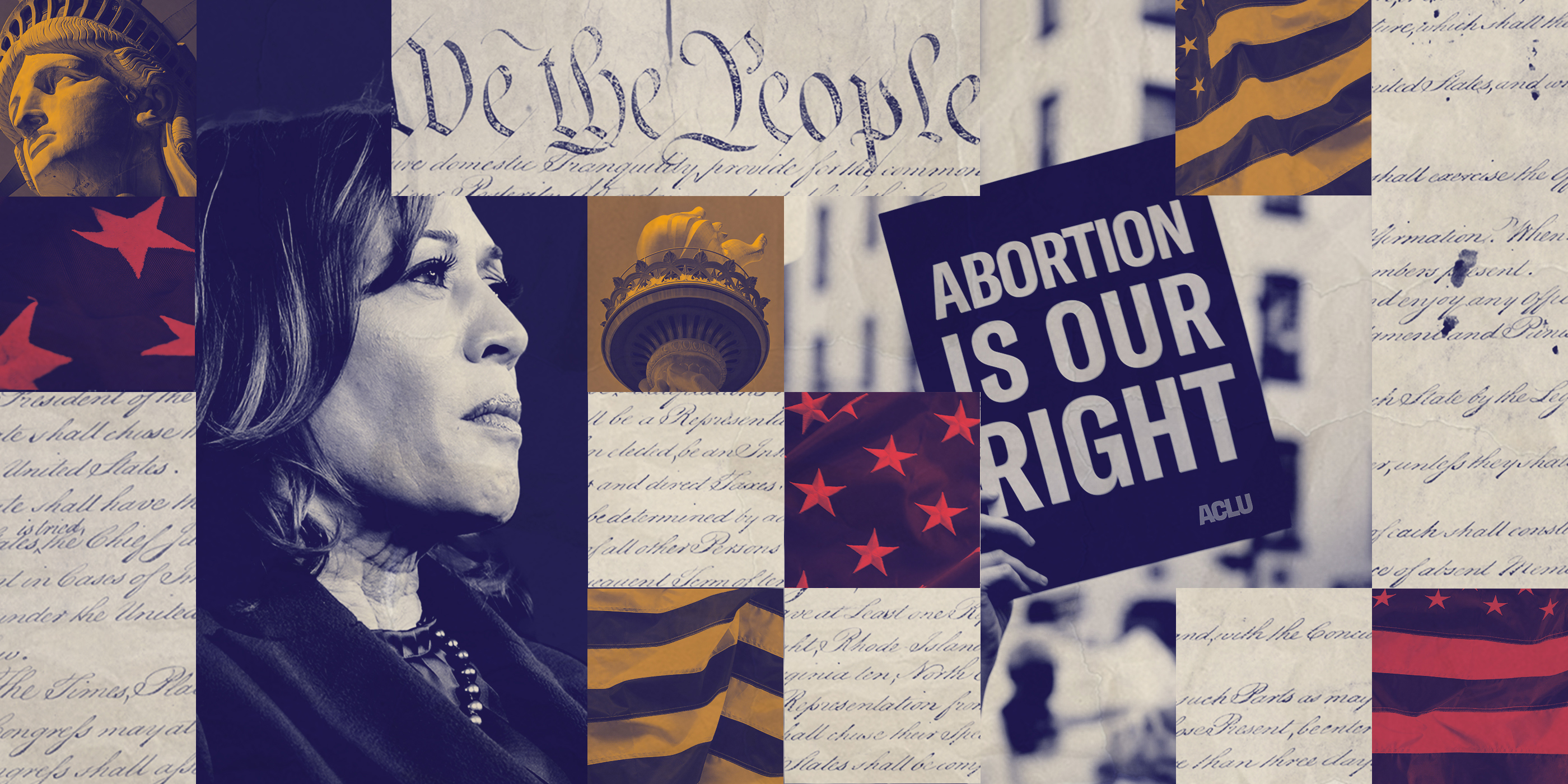
Vice President Kamala Harris, the Democratic party’s nominee, has already indicated her support for abortion access and other forms of reproductive health care. At one of her first campaign events, she stated that if Congress “passes a law to restore reproductive freedom, as president of the United States I will sign it into law.”
The ACLU promises to hold Harris accountable for keeping this campaign promise if she is elected in November. Learn more in our breakdown:
Harris on Abortion Rights
The Facts: The Biden-Harris administration made abortion rights and reproductive health a priority during their four years in office. But anti-abortion politicians have had control of at least one body of Congress ever since Roe was overturned, preventing meaningful congressional action on abortion. Enacting federal legislation to protect the right to abortion throughout the country is a crucial and desperately needed step to rectify the harms of overturning Roe.
To be clear, abortion care was not accessible for far too many even before the end of Roe. If elected, Harris must carry out her promise to restore reproductive freedom by taking bold action to ensure that everyone can get an abortion if they need one, no matter who they are, where they live, or how much money they have. She must not only demand legislation that codifies abortion rights and invalidates state bans and restrictions, but that also ends discriminatory barriers to abortion care, such as insurance coverage bans like the Hyde Amendment.
Why It Matters: Right now, millions of people of reproductive age live hundreds of miles from the closest abortion provider. In 2023 alone, more than 171,000 people were forced to travel outside of their home state to secure abortion access. As a result of abortion bans and other restrictions, countless people are being forced to continue their pregnancies against their will. Some states have gone so far as to criminalize the provision of abortion care in medical emergencies where the inability to get an abortion puts the pregnant person’s health, life, and future fertility in danger.
In the two years since Roe was overturned, however, there has been a groundswell of public support for abortion rights and rising opposition against bans and restrictions on abortion care. People in states across the country — including Kansas, Kentucky, Michigan, Ohio, Pennsylvania, Virginia, and Wisconsin — have repeatedly demonstrated their support for reproductive health care access since Roe was overturned.
How We Got Here: Making good on his campaign promise to end Roe, President Donald Trump appointed three Supreme Court justices who were part of the majority opinion that overturned the 50-year-old decision and took away the constitutional right to abortion. Since then, extreme politicians have increased their attacks on our reproductive freedom, enforcing bans that push care out of reach entirely in 14 states and attempting to use junk science to take an abortion pill off the shelves nationwide. These politicians even threatened to put doctors in prison for providing emergency abortion care to pregnant patients facing complications.
Our Roadmap: As a presidential candidate in 2020, Harris committed to working with Congress to pass a federal bill to codify abortion rights. She also promised to end the Hyde Amendment, which places restrictions on Medicaid coverage for abortion and has forced one in four low-income women seeking an abortions to carry an unwanted pregnancy to term. The Biden-Harris administration took steps to remove this harmful restriction and, if Harris is elected, the ACLU will urge her administration to build on past progress to fulfill her campaign commitments.
In addition to ending the Hyde Amendment and protecting abortion access, the threat of misusing the Comstock Act as a national abortion ban must be eliminated. The Comstock Act is an 1873 anti-obscenity law that regulates the use of the mail and common carriers to send or receive anything that is “indecent, filthy, or vile” or “intended for producing abortion.” Trump’s advisors are threatening to misapply this law, claiming incorrectly that the Comstock Act functions as a national abortion ban. To ensure that no future anti-abortion president can weaponize this antiquated law, Harris must urge Congress to repeal it. The ACLU has already asked lawmakers to introduce the Stop Comstock Act, and we will demand that any legislation codifying abortion rights also repeals the Act.
Additionally, we urge a potential Harris administration to robustly defend pregnant people’s rights and ensure all hospitals satisfy their obligations under the Emergency Medical Treatment and Labor Act (EMTALA), which requires hospitals that receive Medicare funds to provide emergency stabilizing treatment, including abortion, to any patient who needs it. The ACLU will continue to work in the courts and with coalition partners to defend emergency abortion care, including urging Congress to swiftly respond in the event of a Supreme Court decision that eliminates these protections.
Lastly, while the Biden-Harris administration made steps toward expanding reproductive health care and contraception access, it must go further. If Harris is elected, the ACLU will work with her administration to urge Congress to make needed investments in Title X, a federally-funded family planning program that helps low-income people obtain critical health care services for free or at a reduced cost.
What Our Experts Say: “If Vice President Kamala Harris wins the election this year, it will be because she prioritized reproductive freedom as a central tenet of her campaign, but that promise must be met with bold and urgent action. Harris has the opportunity to ensure that Congress enacts federal protections for abortion that reflect the American public's overwhelming support for reproductive freedom. That means demanding Congress send her a bill to sign that ensures everyone who needs abortion care can access it.” — Madison Roberts, ACLU senior policy counsel for reproductive freedom.
What You Can Do Today: Since Roe was overturned, abortion bans have gone into effect in states across the country. Today, anti-abortion extremists continue to attack medication abortion and emergency abortion care. It’s past time to make a change. Join our campaign to urge your congress members to pass federal legislation that safeguards our reproductive freedom.
Comments
Post a Comment